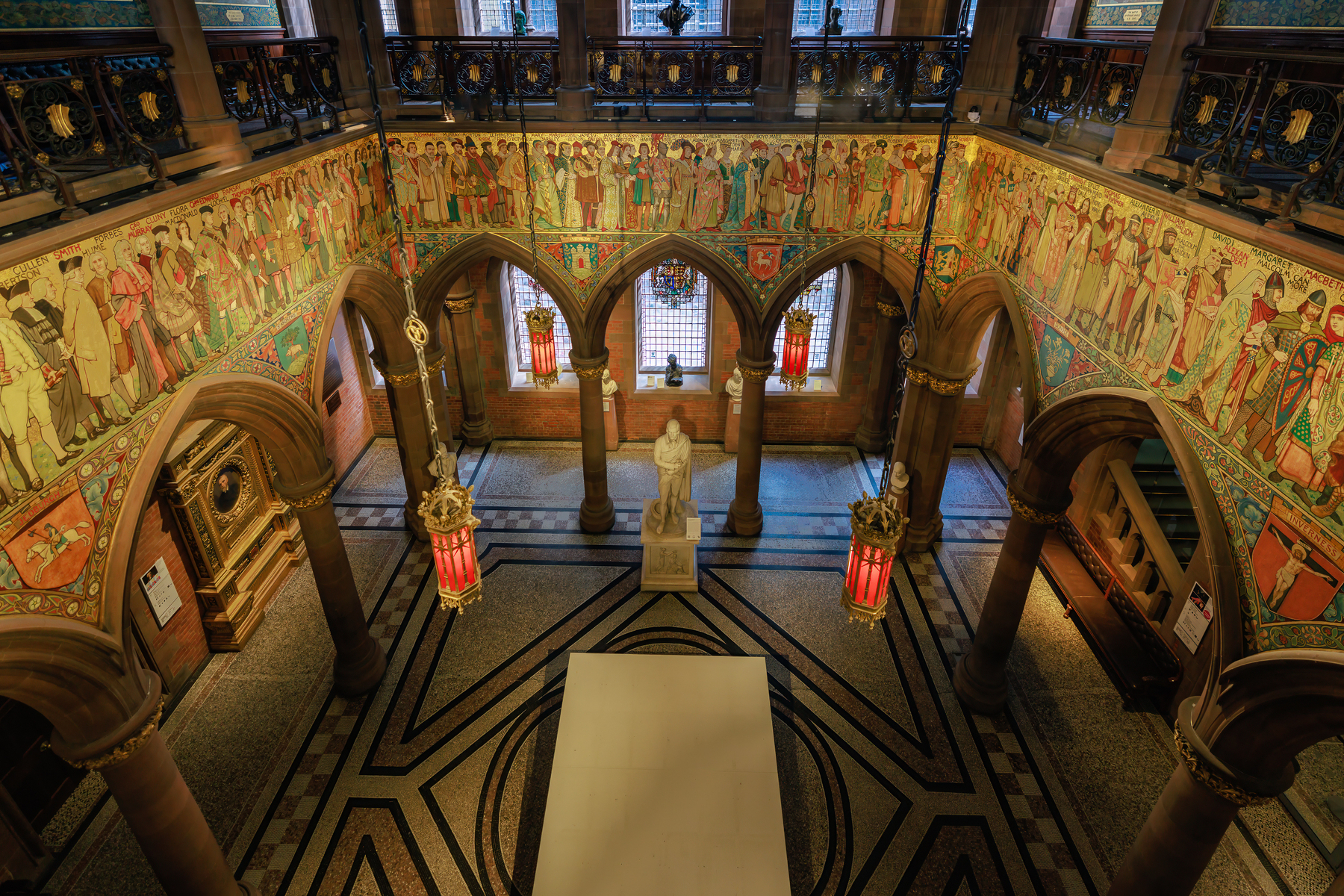
The Procession of Scotland: The Great Hall
The Great Hall of the Scottish National Portrait Gallery, opened in 1889 and designed by architect Sir Robert Rowand Anderson, was conceived as a “shrine” to Scotland’s national history. At its center stands a statue of the historian Thomas Carlyle, surrounded by Gothic arches, stained glass, and richly decorated surfaces.
Encircling the upper walls is a continuous processional frieze painted between 1897 and 1901 by the artist William Brassey Hole. The mural depicts 155 figures from Scottish history, arranged in reverse chronological order—beginning with Carlyle himself and moving back through monarchs, thinkers, and cultural figures to the nation’s prehistoric inhabitants. Each figure is labeled and dressed according to their period, forming a visual narrative of Scotland across time.
Executed in a spirit fresco technique, the frieze was part of the original decorative scheme funded by the gallery’s founder, John Ritchie Findlay. It reflects a late Victorian ambition to present national identity through art, assembling a collective portrait of Scotland within a single, immersive architectural space.